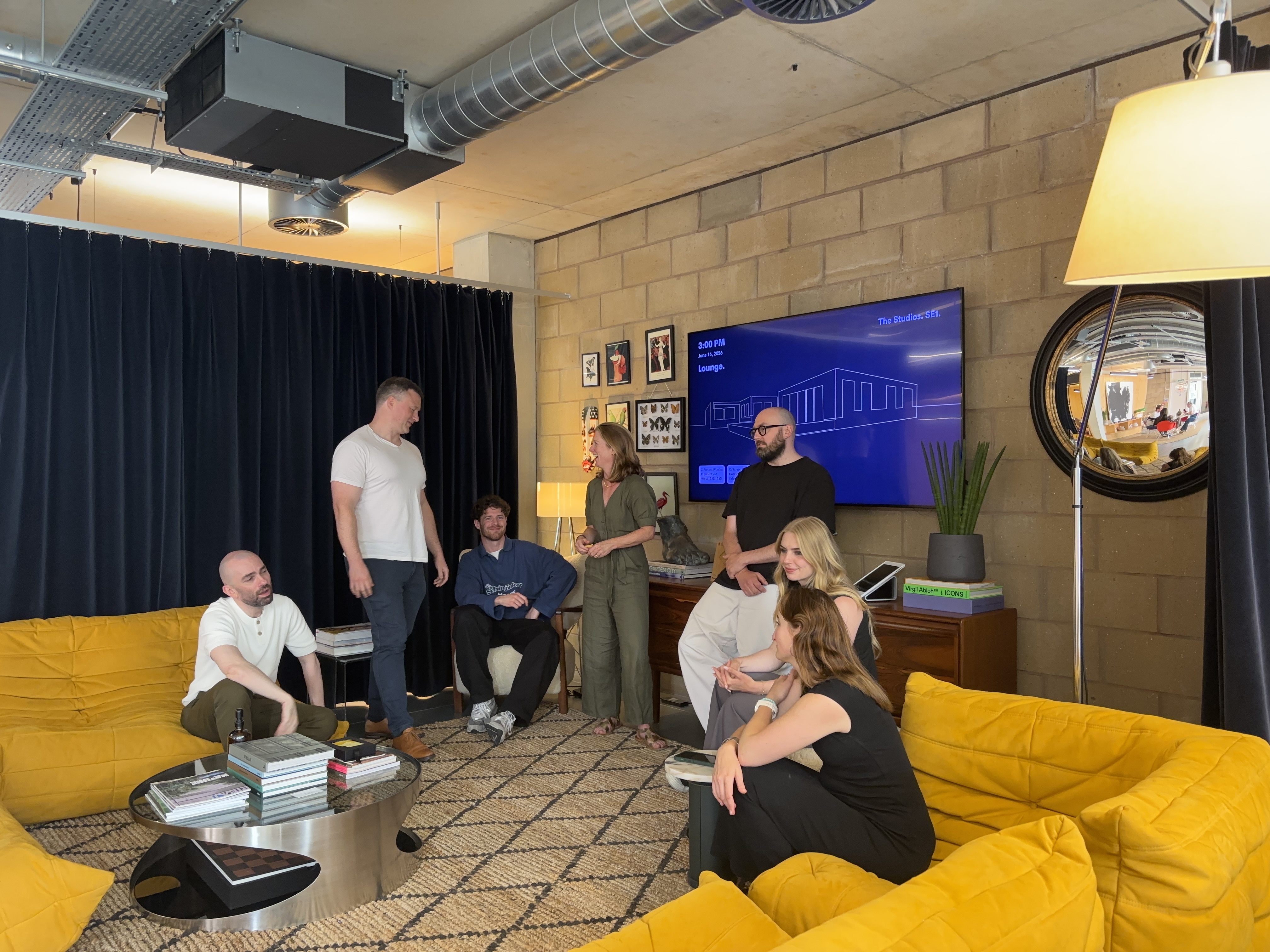

“Brand is not decoration. It’s the thing that distinguishes you,” says Dave Blendis, strategy director at Rowdy Studio. “Most clients have a product that is pretty similar to their competitors. So that is not the differentiator. It is their reputation, their brand.”
It is a timely argument. As AI accelerates product development and lowers the cost of building software, features are becoming easier to replicate. What cannot be copied as easily is trust, recognition and relevance. That is where brand still holds weight.
For Lisa Clarke, who founded Rowdy during the 2008 recession, this moment feels familiar. “I saw a gap when the big agencies were not nimble enough to adapt to what the market needed,” she says.
What began as a design studio has since evolved into a more strategically-led business. Since 2018, Clarke has deliberately built out Rowdy’s strategic capabilities, creating a senior team that now includes Blendis and design director Tomas Morren.
Today, the agency works with what Clarke describes as “businesses that are shifting gear”. Companies at a point of change. No longer early stage, not yet fully realised, and often carrying a story that no longer matches where the business is heading.
“Their brand is very much stuck and that story has not caught up,” she says. “They need clarity in order to keep growing.”
The Brand Compass
That need for clarity shaped one of Rowdy’s defining tools: the Brand Compass.
Rather than separating strategy and design into neat sequential phases, Rowdy blends them together. Traditional agency models often treat strategy as something signed off before creativity begins. Rowdy sees that as limiting.
“A lot of agencies work in a conveyor belt way,” says Blendis. “The client gives you something, you take it away, come back with a strategy, they sign it off, then you go away again and come back with a design. We do not work like that.”
The Brand Compass maps a client’s core tensions across two strategic axes, creating four possible territories for the brand to occupy. Each territory becomes a route explored through references, creative directions and early design thinking.
For Solutions Not Sides, an educational charity navigating the Palestine-Israel conflict in schools, one tension was authority versus grassroots expression. Another was personality versus calm neutrality.
“We use that axis to explore design,” Blendis explains.
Morren adds that the process stops aesthetics from becoming arbitrary. “We are using design to prove how the brand can exist depending on the positioning they take.”
The outcome is rarely a single neat box. More often, Rowdy helps clients identify a combination of territories that feels truest to the organisation. Strategy is then refined through what has been learned creatively.
“Strategy and design do not become separate stages,” says Blendis. “They inform each other.”
When brand creates enterprise value
That approach was tested with Calypso AI, an Irish technology business building security tools for enterprise AI adoption.
The opportunity was clear. Businesses were rushing to use tools like OpenAI ChatGPT, often without understanding the risks of sensitive data exposure. Calypso had a strong product, but needed a brand capable of matching the scale of the moment.
“They saw a real opportunity to go very quickly from being very small to a leader in this emerging category,” says Blendis.
Rowdy developed a brand designed around that ambition. The company was later named one to watch by Forbes, before being acquired by F5 for $180 million.
“The client themselves acknowledged that the work we did was a huge part of that acquisition happening,” says Blendis.
For Morren, it was also a reminder that great branding is not always about permanence.
“Every designer probably has that desire to create a brand that lives on forever,” he says. “But sometimes a brand’s role is to help a client get to the next stage.”
Building for the long term
If Calypso was about speed, Glass Bottle is about patience.
The 37-acre mixed-use development in Dublin is being built on the site of a former glass bottle factory and will unfold over the next decade. Rowdy is two years into what is expected to be a long-term partnership spanning identity, placemaking, engagement and activation.
“It is about regeneration of a whole area,” Clarke says. “Building a town within a city.”
The scale of the challenge is different. The brand must work across residential marketing, commercial leasing, community initiatives, events and public perception, while remaining coherent over many years.
“This is the first of its kind in Dublin,” says Blendis. “The brand needed to feel exciting and engaging, and that it was for Dublin and the people of Dublin, not just a commercial development.”
Why senior teams stay involved
Rowdy’s model is also shaped by structure. The agency remains deliberately flat, with senior leaders involved throughout projects rather than appearing only at pitch stage.
“The most experienced brand professionals can add huge value in the detail,” says Morren. “That is where the brand is really refined and sharpened.”
It also avoids a common agency frustration, where the people who win the client relationship disappear once delivery begins.
“With us, we are the people that do the work,” says Blendis. “We build that relationship and we deliver it.”
For Clarke, autonomy still matters. “You have to give space for the team to grow and have a voice. People feel invested when they know they are there for a reason.”
The next advantage
Looking ahead, Rowdy believes the value of brand is rising again.
As products become easier to build and copy, distinction shifts elsewhere. Into reputation. Into memory. Into the signals people trust when choices become crowded.
“When I started out, brands lived in print and a little bit in digital,” says Blendis. “Now they live in voice, in AI, in places without screens. How businesses project reputation keeps changing as technology changes.”
That may be the strongest case for branding now. Not as decoration, but as durable advantage.



.jpg)

