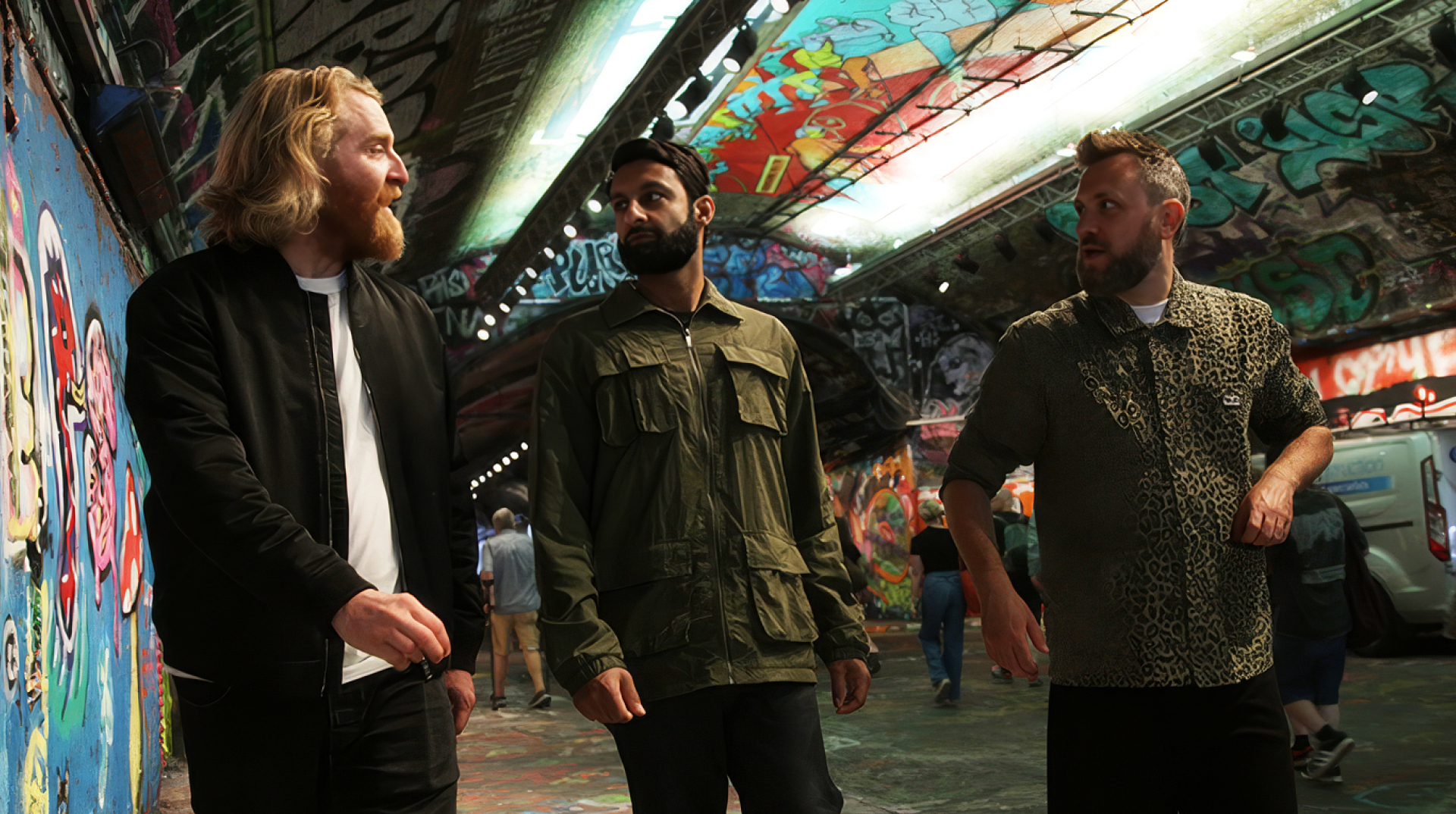

"We don't present the work until everybody in the room is comfortable that we've respected their timelines and the amount of money they have to spend," says Neil Shanlin, Chief Creative Officer at Execute. "It means clients can sit and relax and enjoy the ideas we have, knowing there's no rug-pull at the end."
It's an unusual pitch. Most agencies lead with creative, then reveal what it costs. Execute does the opposite. Every concept they present is guaranteed to be deliverable within the stated budget and timeline. No exceptions, no surprises, no apologetic follow-up emails about scope.
Neil founded the London agency last summer with Pranav Arya, CEO, and Tony Powell, COO. The three had worked together nearly a decade earlier at AMV BBDO, where they were instrumental in establishing the agency's dedicated in-house moving image production company and content arm. After years apart, they reunited around a shared observation: clients were, too frequently and with much irritation, being shown work they couldn't afford.
"We spent the first few months after establishing doing a lot of listening," Neil explains. "We went and spoke to as many marketing leaders as possible to find out what their frustrations were." The pattern was consistent. Brilliant ideas in the room, budgets that made them impossible to deliver, and a creeping sense that the presentation of creativity had become disconnected from the reality of making it.
Execute's model is built on an unusual structure. Two producers and one creative working as a trio means every idea is stress-tested for feasibility before it leaves the building. "Any ideas we put forward to clients, to brands, we guarantee can be made for the time and the money that they're putting forward," Neil says. "That was the exact opposite of the experience these brands had been having up to this point."
Tight budgets aren't buzzkill. They’re the buzz.
One of Execute's early projects was with Numan, the health consultancy that delivers medication and medical advice via app. The brand had just spent heavily on an above-the-line campaign and had very little left for social work. The brief included too many scripts and not enough money.
"It sounds like the creative work ended up being compromised," Neil admits. "Far from it. We were just able to find really clever ways of utilising body doubles, the same costumes from the above-the-line work, and some really clever camera angles to mask any limitations."
Numan came back with another brief, then another. Out-of-home followed, then radio, then TVCs. "Once we demonstrated our approach to them, they were like, 'What can you do with this? What can you do with this one?'" Tony recalls.
But Execute keeps encountering a psychological tension. Clients apologising for their stretched budgets. "One of our most recent clients, a tech start-up, only had £6,000," Neil says. "There was a sheepishness there. He was acknowledging it was going to be a tall order. But we were still able to make something work, and deliver a whole range of assets for them, that exceeded their expectations."
Pranav is direct about where that shame comes from. "The industry has conflated the size of budget with ambition. What we believe is keeping that budget in mind is not a lack of ambition. If anything, it's the opposite."
When you write to budget from the start, he argues, you're not cutting corners later. You're not losing the production manager, the third camera for extra coverage, or the extra social assets the client wanted. "The intentionality is: this is the money we have, this is what we require. Let's come up with work that satisfies both."
The alternative wastes time and dilutes the work. "You end up spending your time arbitrarily writing multiple budgets and schedules without focusing on what the real problem for the client is, which is they need a campaign to solve a business problem."
A feature documentary in six months
Execute set themselves a series of challenges when they launched. One was to produce a feature-length documentary. They managed it within six months.
The People’s Emergency Briefing started as an event film for Climate Science Breakthrough, a client Execute had worked with on comedy films pairing climate scientists with comedians. The brief began life filming coverage of The National Emergency Briefing, a Westminster event featuring nine climate scientists speaking on topics from economics to food security.
“The end goal was to then translate these high-powered climate science talks into an urgent, more light-hearted, and human experience” Tony explains. “Something more people could feel together.”
The finished documentary pairs the scientists' talks with a Gogglebox-style format. Chris Packham leads members of the public and celebrities including Jennifer Saunders and Deborah Meaden through the talks, capturing their reactions and discussions. The film is BBFC-certified and has been subtitled in roughly 20 languages.
The distribution model broke convention. The client made the film available in multiple formats and invited anyone to host a screening. Over 4,000 screenings have taken place globally. The film will feature on BBC’s Panorama later this year.
Tony reflects. "To do something that feels like you might be doing something in the right direction, to the benefit of everyone, makes us extremely proud."
The generalist returns
Tony rejects the idea that specialisation is the only route to credibility. "Recently, the term ‘generalist’ has become a bit of a dirty word amongst the production and creative community. But I completely reject that."
Execute's range reflects that philosophy. They've made TVCs, radio, out-of-home, micro dramas, branded documentaries, social content and feature-length films. They work with other production companies and agencies on co-productions when it makes sense. "It doesn't have to necessarily be us producing it all," Tony says. "We'll produce this bit, but this bit needs this person to do it. We're still helping to manage it from an overall perspective."
Neil sees this as part of a broader industry shift. "I don't think anybody wants to be dictated to. We are entering into a really exciting era of choice."
He's particularly interested in the rise of in-house agencies, especially in the UK. "They're being populated by people who've come from agency side, who were disenfranchised with how the big holding companies used to run. Now they're interested in doing things differently and working directly with independent companies."
Those in-house teams understand the value of collaboration at speed, Tony adds. "The brands can see through all of this. A lot of them will be tied into complicated master service agreement deals with bigger agencies, but a lot aren't."
What brands don't realise they can get
Execute wants clients to understand they're not just a production company. "We don’t just produce the work, but we can conceive it as well," Neil says. "They can come to us with a problem, a target market they're wanting to attract. If they give us the time and budget, we can write the work and execute it in one fell swoop."
Pranav believes brands would be surprised at what things actually cost. "Come to us and we can show you—you don't need half a million to shoot three days in the UK. Or actually, your £200,000 budget could still get you over 250 assets as well as a feature documentary."
For Pranav, everything Execute has built points in one direction. "Fundamentally, when we set up, everything we built towards is making work. What is the quickest way for us to work with you, to get your work made and out there working for you? That's writing to budget. That's talking about money upfront. That's not having an office because we don't have to pay rent, and that money can be used towards the work."
Neil puts it simply. "To execute is to do."




.jpg)

