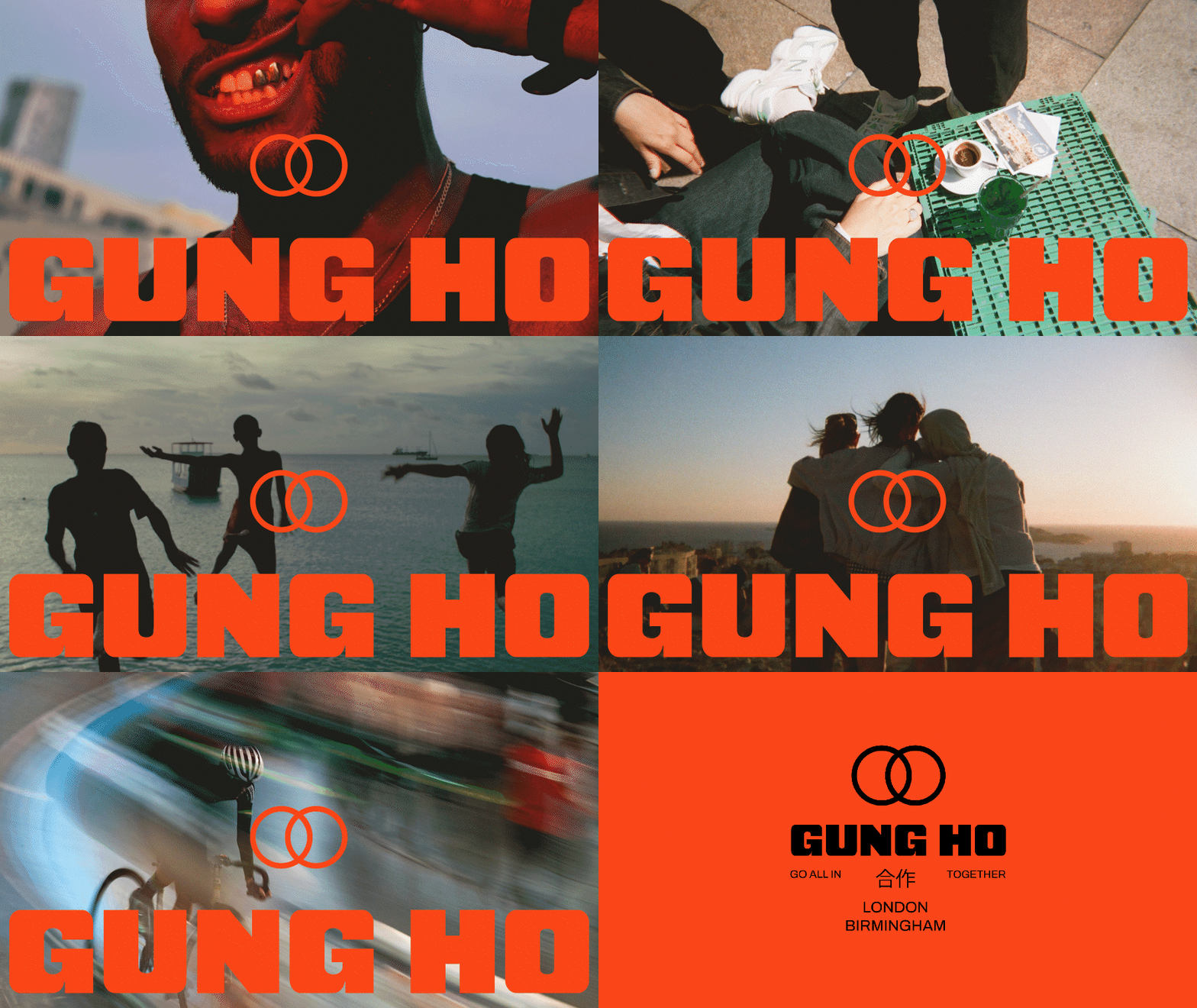

“I listened to my gut and acted. Sometimes that’s the bravest decision you can make.” says Paul Phedon, recounting his spontaneous leap from corporate executive to agency founder. "No grand plan, no business plan, literally on a whim. I just felt it was the right thing to be a little bit brave."
Twenty years after making that decision, Paul’s Birmingham-based agency Gung Ho celebrates its second decade with an impressive roster of long-standing clients, some relationships spanning 16 years and a distinctive position in the sport, fashion and lifestyle sectors.
While countless agencies now trumpet their cultural credentials, Paul's approach was embedding brands in authentic cultural moments long before it became marketing's favourite buzzword. His journey from Speedo's VP of Marketing to independent agency founder offers valuable insights into how sector specialisation, regional identity, and what he calls an "uncompromisingly professional but very informal style" can create enduring client partnerships.
The accidental entrepreneur
After nine years at global sports brand Speedo, culminating in the VP of Marketing role, Paul found himself increasingly reluctant to board yet another international flight.
When an unexpected opportunity presented itself, Paul made a snap decision that would define the next two decades of his career. This spontaneity might seem at odds with agency leadership, but it established a pattern of decisive action that would become characteristic of Gung Ho's approach. What Paul championed was deep sector expertise and boardroom experience that proved invaluable in the agency's early days.
"I was able to fast-track really strong effective commercial conversations with clients from the start with empathy," he explains. "I'd been in quite a senior position in the boardroom listening to really detailed complex commercial discussions about running a business. That's been priceless."
Regional roots, global ambition
Setting up in Birmingham rather than London was another decision that shaped the agency's identity and one that met with industry resistance.
"I came across a lot of snobbery in the industry," Paul notes. "But I believe that being originally based in Birmingham and that spirit actually shaped us. We weren't trying to be a cool London setup. We just rolled our sleeves up, got on with the job under the radar, and the clients loved that."
This regional identity fostered what Paul describes as a "grounded, resourceful and ego-free" approach that won clients over. It's a positioning that has served them well, even as they've expanded their London presence, where most of the team is now based, and international work.
The agency's name itself reflects this collaborative ethos. "The literal meaning of 'Gung Ho' in Chinese Mandarin is 'work together,'" Paul explains. "The perceived meaning is 'let's just get on with it, go', so the magic of both is we can work with the perceived and we can work with the literal."
Truth told boldly: The Gung Ho proposition
When asked what differentiates Gung Ho, Paul points to several factors: their fierce independence, limited hierarchical layers, sector immersion, and earned-first mentality.
"We're always earned first in everything we do," he emphasises. "That's the mentality, that's the approach, and I think that's so relevant today."
The agency has recently crystallised its proposition around "truth told boldly", immersing themselves in a truth (whether brand, sector or consumer) and telling that story in a compelling way. "Even though we've been doing that since day one, we've defined it much better now," Paul notes.
What energises the team most are clients with ambition who want to be brave. Paul cites one client who asks them to respond to briefs in a "50/30/20 way", 50% should be a solid response to the brief, 30% should push boundaries, and 20% should "scare the hell out of us and let's go somewhere, and if we fail we fail but we try something new."
Balancing creativity with commerciality
For all the talk of boldness, Paul is refreshingly pragmatic about what constitutes success. "What's really important for us is to balance creativity with commerciality," he states. "I know that we can be really creative but actually not just for creativity's sake."
He expresses frustration with agencies that create work specifically for awards rather than client objectives. "The best success we have is when we deliver on the objectives for the client because it's irrelevant otherwise," he argues. "We can have such a great idea but if it doesn't land and it doesn't drive what they want, there is actually no point in that."
This commercial focus has delivered tangible results. Recalling an early project for Speedo, Paul says: "We smashed every result from a PR perspective, but they came back and said, 'Well, look, there's a waiting list for this product and the share price has gone up.' I couldn't actually ask for any more."
From global launches to regional communities
The agency cut its teeth on ambitious international projects. Shortly after founding Gung Ho, they pitched to handle a simultaneous product launch for a key client in Sydney, Tokyo, New York and London on the same day.
"This small little agency in Birmingham hit them with a big idea," Paul recalls. "I sent a team member to each of those countries to manage them with local teams. It was a huge project even by today's standards."
This willingness to think big while maintaining meticulous execution has remained a hallmark of the agency's approach. However, Paul is equally proud of their work developing authentic connections at a local level.
"We've been doing a lot of work in community, it's the new currency, particularly in culture," he explains. "We've developed a running club strategy where we've connected clients with local communities that all have different propositions. We're not coming in brand-down to take over, but coming to support those communities, help them deliver what they want to do."
Looking ahead: earning attention in a distracted world
As Gung Ho enters its third decade, Paul remains excited about the potential to expand their cultural expertise to new brands. "Whilst we've been working a lot with brands in this sector, I believe that we can bring brands into this space who are interested in being embedded in culture in a relevant way," he says.
He's particularly enthusiastic about "how creativity can still deliver the results that clients are looking for," especially in social first, entertainment led approaches. "More work that earns attention as opposed to buys it is really the way to go," he asserts.
After 20 years of evolution, Gung Ho's founding principles, sector focus, cultural relevance, and collaborative spirit, remain intact, even as the agency continues to adapt to changing market demands. For brands seeking authentic cultural connections, their blend of strategic thinking and practical delivery offers a compelling proposition, one that has sustained two decades of growth and shows no signs of slowing down.


.jpg)

