.png)
.avif)
Last year, TikTok creator @heylej posted a video calculating her total screen time for 2025. She'd spent 130 days of the year on her phone. The video has been viewed 4.7 million times, and the comments are full of people doing the same maths and feeling sick about the answer.
That clip captures something broader. According to ExpressVPN, 46% of Gen Z are actively taking steps to limit their screen time. Dumbphone sales surged 25% in 2025. Experts are calling it a 'dopamine diet'. The most digitally native generation in history is choosing to go backwards.
For brands, this creates an urgent question. Not whether screens still matter, of course they do, but what role they should play. The average person over 15 still spends 7.5 hours a day on screens. That's an enormous amount of attention. But when reduced screen time becomes aspirational, every second of that attention becomes more contested, and what you do with it matters far more than how much of it you capture.
A new whitepaper from Spark, the global content production agency, makes a compelling case that the screen should be treated as a gateway: a starting point that leads people toward richer, more sensory, more human brand experiences. The data above suggests that framing has never been more urgent. If your audience is actively trying to spend less time on their phone, every moment you do have their attention needs to lead somewhere meaningful.
So what does that look like in practice? We found three patterns worth paying attention to, each operating at a different scale.
The model: screen to street
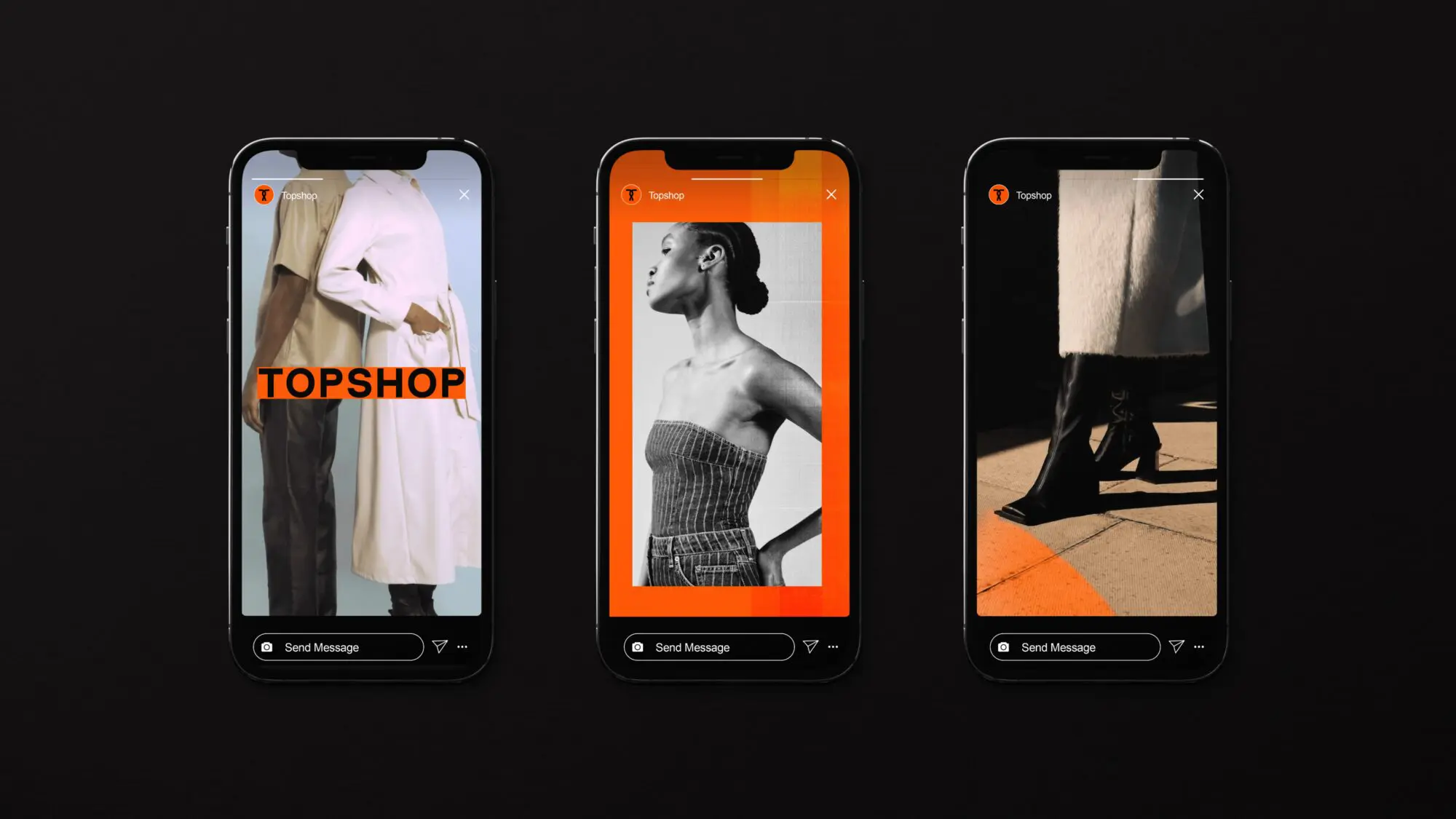
The purest example comes from Topshop's relaunch as a standalone brand last year. After five years existing only as a sub-brand on ASOS, Moses Rashid, Topshop's global marketing director, chose to announce the comeback with a teaser on social media, 'We missed you too', before staging a public runway show in Trafalgar Square in August. Not during fashion week. Not behind closed doors. An open-air show on a Saturday afternoon, with Cara Delevingne and the Mayor of London in the front row and the general public lining the square.
'It was really important to us that our audience could come and experience our first runway show in nearly a decade,' Rashid explains. 'They brought an incredible energy which saw us enjoy this moment together.'
The relaunch generated 1.7 billion in digital reach. But the social moment was a byproduct of the real-world event, not the other way around. The screen got people's attention. The experience in Trafalgar Square converted that attention into something lasting.
Rashid describes the funnel he's building as taking people from transactors to fans. 'You do this by doing interesting things on various channels, but also IRL experiences, and then you fuse the two together. It's thinking about how you can provide those money-can't-buy experiences. As a marketer, we need a direct dialogue with our audience.'
That is the gateway principle in action. Digital reach creates the spark. The physical experience creates the connection. And the content that follows is earned, not manufactured.
Without the big stage: partnerships as a shortcut
Trafalgar Square is a headline act. But the same logic works without a landmark location or a celebrity front row. For the marketing majority, partnerships are often the most efficient way to get your brand into physical spaces and in front of new audiences.
Lulu Guinness, a heritage luxury handbag brand, spent 2025 doing exactly this. Chocolate boxes in Waitrose. A wholesale stocking with John Lewis. A special edition biscuit tin for Biscuiteers, followed by a takeover of the snack brand's West London café during London Fashion Week. As their former CMO John Sadeghipoor explains: 'By teaming up with organisations in the food space, it prompts a different emotion to that evoked by fashion. But importantly, it opens us up to another market and means we're showing up in spaces when the consumer is in "shopping necessity" mode.'
None of this required a massive media budget. It required imagination and a willingness to step outside the category. The café takeover is a physical experience. The Waitrose stocking puts the brand in front of a completely different audience in a completely different mindset. Both generate conversation, social, PR, word of mouth, without needing a content calendar to make it happen.
The gateway here isn't a single social post. It's the brand showing up in an unexpected physical space, which then ripples outward through earned channels. Same principle as Topshop, different scale, different budget.
At scale: building the gateway into the brand
eBay shows what happens when you build this approach into your ongoing brand strategy, rather than treating it as a one-off moment.
The marketplace has established multi-year partnerships with Love Island and Condé Nast to position itself as a 'preloved' partner. Maria Betés, eBay's head of marketing, describes it as showing up where fast fashion always showed up. And then showing up as preloved. 'The unexpected tie-ups can have the best cut through,' she says.
But eBay has gone further, stepping off the screen entirely. At last year's Goodwood Festival of Speed, the brand created an immersive 'Garage' experience to showcase its parts and accessories marketplace: live competitions, escape-room challenges, and hands-on activations that turned visitors into participants. The content that came out of it was a natural byproduct of the energy in the room, not the other way around.
As Ben McMahon of experiential agency Collaborate Global, who delivered the activation, argues: experiential should be positioned as a growth driver in the marketing ecosystem, not treated as a one-off stunt. eBay's approach demonstrates what that looks like when the partnership strategy and the physical activations reinforce each other over time.
What this means for the marketing majority
Three different brands, three different budgets, one consistent pattern. The screen captures attention. The experience converts it. And the social content that matters most is the kind that's earned from real moments, not scheduled from a content calendar.
As Lisa Miles, director of strategic growth at Outernet London, puts it: 'When people become part of the brand experience, they are then invested and committed on an individual level.'
For mid-market brands, the temptation is to retreat further into performance channels: the measurable, the optimisable, the safe. But performance media without brand equity is a treadmill and the dynamic has only intensified. Justin Reid, Tripadvisor's senior director of media, predicts a return to what he calls 'good old fashioned brand building' in 2026. 'Brands that can be a genuine and ongoing social relevance to consumers are the ones that will flourish,' he says. 'Authenticity will continue to play a bigger part, less "influencers", more "influential people".'
The opportunity is to look honestly at where you're currently spending on forgettable content. The posts that get scheduled, published, and forgotten by everyone including the team that made them. Redirect even a fraction of it toward experiences that create genuine cultural moments. A pop-up. A partnership. An activation. Something that gives people a reason to talk about you without being prompted by an algorithm.
A 2025 Harris Poll found that 81% of Gen Z wish it was easier to disconnect from digital devices. That doesn't mean screens are finished. It means the role of the screen has changed. The brands that treat every digital touchpoint as a gateway to experiences, to community, to something worth remembering, are the ones that will earn the right to the attention that remains.
Amar Chohan, Founder and CEO - Department of Creative Affairs.
Looking for a new agency? DCA cuts through the noise to connect brands with agencies that fit
- We cover all types of projects and disciplines, from strategy and creative to performance and tech.
- Our editorial team vets every agency, so you skip the pitch theatre and get straight to capable partners.
- We offer consultancy, pitch management, or a complimentary shortlisting service if that's all you need. Submit a brief today

.jpg)
