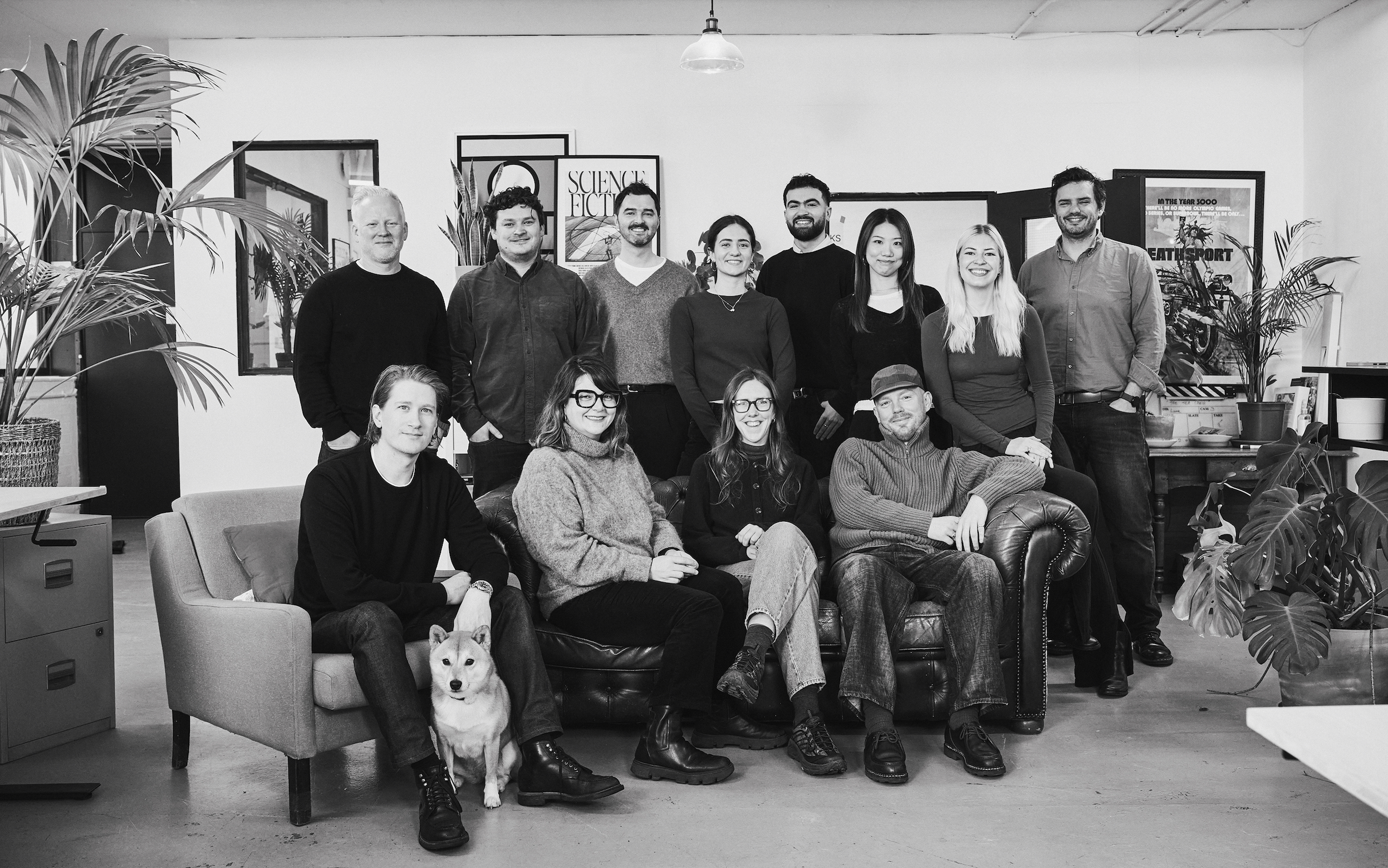

“The agencies I worked with didn’t necessarily understand the constraints of the business or what was going on in a marketer’s mind,” reflects Martin de Fleurian, founder of House of Greenland - a boutique agency quietly competing with industry giants. After years at Google, where he helped launch brand marketing in the UK, de Fleurian spotted a fundamental disconnect between agencies and clients. That gap would eventually inspire him to build something more closely aligned with how marketers actually think and operate.
In an industry where agencies often operate as service providers rather than strategic partners, de Fleurian and CEO Nicole Haines have created a marketing-first agency that prioritises empathy, transparency and long-term relationships over transactional work.
“Essentially, for me, we’ve created the same environment as what fast fashion did to a degree. Constant iterations and new campaigns rather than looking at sustainable clarity that impacts and really moves the needle” says Haines.
The birth of a distinct agency model
De Fleurian’s journey from tech to agency life was anything but conventional. “My baby was born on 19 March and the company went live in June,” he laughs. “This is a terrible approach to risk. This is not advice. You should not do this.”
What started as a bootstrapped content production studio has evolved significantly over the past decade. In its early days, the agency focused on social and B2B production, largely because that was what was immediately available. But the ambition was always broader: to build the kind of agency partner de Fleurian wished he had been able to work with as a client.
Over the years, the industry has shifted dramatically. COVID-19, economic uncertainty and rapid technological change have forced the agency to adapt while staying true to its principles. Most recently, the rise of AI and in-house teams has driven a strategic refocus.
“We really honed in on what clients genuinely value us for and where we see the future of the industry going,” says Haines. “The integrated piece still exists, but it’s less dominant than it was before.”
Marketing literacy as a differentiator
In a crowded market, what truly sets the agency apart is its marketing literacy, not just advertising literacy. That distinction fundamentally reshapes client relationships.
“In the early days, people would come to us and say, ‘Can you make us a video?’” de Fleurian explains. “And the answer was always, ‘Yes, but why do you want a video?’ We want to understand the actual marketing challenge.”
That approach has delivered results across sectors. For Flo, the world’s largest period-tracking app, the agency helped shift communications away from purely transactional app promotion towards positioning the brand as a trusted source of women’s health information.
“Seventy-five per cent of women in the US never see an OB-GYN,” de Fleurian notes. “So their only source of intimate health advice is the internet. You either ask your mum and feel judged, or you Google something and leave convinced you have cancer.”
Rather than amplifying anxiety, the agency developed clear, educational content around topics like vaginal discharge, what is normal and what isn’t. This positioned Flo as a reassuring, credible guide. The strategy proved effective and laid foundations the in-house team continues to build on.
For Google, the challenge was differentiation in B2B advertising, a space crowded with brands promising the same thing: growth.
“If you tell me ‘make more money’, you’re invisible. You’re advertising the category,” says de Fleurian. “That’s not how you win.”
Instead, the agency built a platform centred on Google’s unique role in decision-making. If you want to be where the world decides, you need to be present on the journey people actually follow. The result significantly outperformed previous efforts.
In-housing and the changing value of agencies
The rise of in-house teams has further reshaped agency relationships. As brands internalise production, they are turning to external partners for high-value strategic input.
“A lot of the noise in agency relationships came from mass asset production,” says de Fleurian. “That’s disappearing. Now clients want advice that benefits from distance. When you’re inside an organisation, you do your best, but you become myopic.”
This shift favours smaller, senior-led agencies that can offer clarity and challenge. Haines agrees: “There’s a move away from being a service provider. The industry has been built on campaign output, for me those days have gone. It’s about advising, shaping and helping brands at a business level.”
The result is a more consultative partnership. As de Fleurian puts it, “consultants who can execute creatively”. Unlike traditional consultancies that diagnose problems and walk away, this model combines insight with delivery.
The clients that matter most
Not every client is the right fit. The agency thrives with two types: established brands hitting a plateau and needing reinvention, and fast-growing scale-ups struggling to keep pace with their own success.
“We love organisations that need to evolve,” says Haines. “Either they’ve stalled, or they’ve grown so fast they haven’t built a strong brand position yet.”
What energises the team is a real problem with lasting impact. “Not something that comes and goes,” says Haines, “but work that genuinely changes things.”
The ideal client brings urgency, ambition and openness. “Pressure is a gift,” de Fleurian adds. “Clients who want to manage the status quo are probably not right for us.”
His invitation is deliberately blunt: “If everything’s burning, or if you want more, come to us. If you’re fine, that’s great.”
A considered agency culture
Internally, the agency operates with a level of transparency that de Fleurian found rare in communications, particularly in London.
“Our business is collaborative,” he says. “That doesn’t mean no leadership, but good ideas can come from anywhere.”
That honesty extends to client work. The agency regularly turns down projects that don’t make sense and advises clients to use other solutions when it’s more economical.
“I’d rather take a short-term hit and build trust long-term,” de Fleurian says.
This philosophy contrasts sharply with industry norms. “In big networks, people are under constant anxiety, working late because they’re scared of losing their jobs.”
For Haines, who recently stepped into the CEO role, sustainability is non-negotiable. “I want us to be commercially strong, doing work we’re proud of, but also a place where people enjoy working and have balance.”
Looking ahead
Looking to the future, both leaders are excited about what’s next. De Fleurian, stepping back from day-to-day operations, jokes about “finding new ways to mess up as a founder, not a boss”.
It comes down to senior-level partnerships. “CMO-level relationships where we help define the strategy and then execute it properly,” says Haines.
In an industry dominated by short-termism, the agency is offering something rare: a genuine partnership grounded in marketing literacy, strategic clarity and honesty.
“Being self-interested will get you ahead in the short term,” de Fleurian concludes. “But being open, decent and truthful is the only strategy that actually lasts.”



.jpg)

