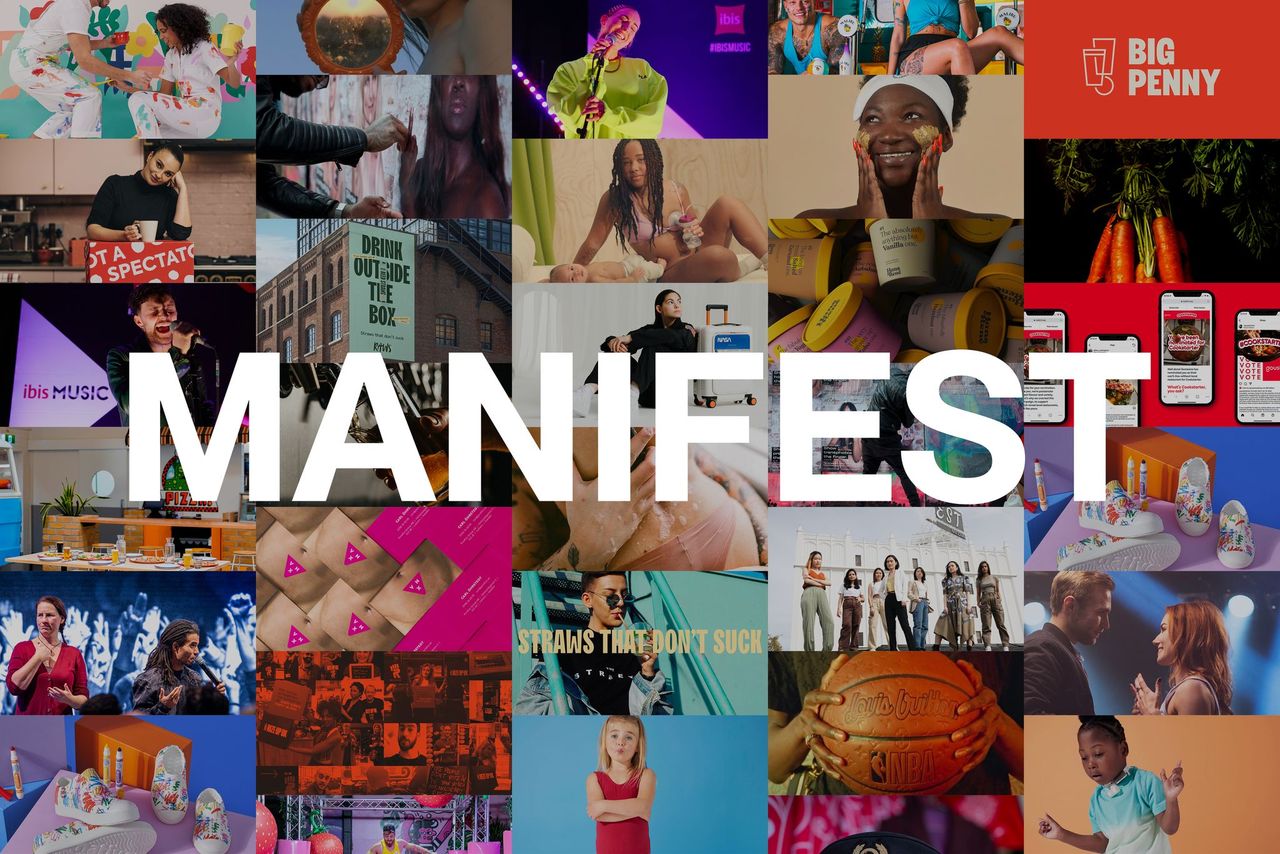

Alex Myers, founder of Manifest, doesn't mince words about the agency's mission: "We build brands that change the world. We build brands to sell products, not the other way around."
It's a bold statement from an agency that began, like many others, with "a heady mix of naivety and bravado" in 2009. But 16 years later, Manifest has evolved into what Myers calls "the cultural impact agency", a description that feels less like marketing speak and more like a strategic framework that's reshaping how brands approach their place in culture.
The agency that refuses to be mediocre
"I wanted to be the first agency defined by how we work, not just who we work with or the channels we work in," Myers explains of Manifest's origins. "I said at the outset, I don't want this to be anything mediocre. It has to be something that feels like it's transforming the industry or crash and burn. There is no in between."
This all-or-nothing approach has yielded an agency that defies traditional categorisation. While most agencies are built around specialisation, a specific channel, industry, or geography, Manifest was designed to put the work first, with a focus on cultural impact rather than channel execution.
This philosophy has attracted clients ranging from startups to global powerhouses like Samsung, Sony PlayStation, Channel 4, BrewDog, ASOS, Campari Group, and Diageo, all seeking what Myers describes as "cultural impact by any media necessary."
From surviving to significant: the three types of brands
Myers offers a compelling framework for understanding brand evolution that cuts through industry jargon: "There are three kinds of brands. There are surviving brands which are on a race to the bottom, price based, offer the same thing as everyone else. They don't even really have a brand. They just have a product."
The second category comprises "successful brands" with first to market advantages, think Uber, but Myers argues this success is "a hamster wheel of innovation" requiring constant reinvention to maintain relevance.
The third category, where Manifest aims to position its clients, is what Myers calls "significant brands" that "measure success by the positive impact they have on the lives of their customers."
Apple serves as his prime example: "Apple has never once invented a technology ever. What it has done is invent you wanting to use it. It is a brand. It is not a technologist."
This distinction between product innovation and brand significance underpins Manifest's approach to client work. "The briefs that excite us the most are the brands that are looking for significance, that are looking for lasting success through a positive impact on audiences," Myers explains.
The boob life: from stigma to cultural shift
Perhaps Manifest's most transformative work was "The Boob Life" campaign for baby brand Tommy Tippee. What began as a brief to sell breast pumps evolved into a movement that changed social media policies worldwide.
"When we spoke to mums, we spoke to two and a half thousand mums around the world, and all of them talked about the stigma of breastfeeding being something that they didn't expect," Myers recounts.
The resulting campaign featured real mothers in authentic breastfeeding situations, content that was promptly banned across social media platforms. But rather than backing down, Manifest leveraged this censorship to highlight the very stigma they were fighting against.
"That doesn't just mean you have to take our word for it that stigma exists. It's literally been codified into our technology," Myers explains. The backlash was so significant that platforms including LinkedIn, Meta (Facebook and Instagram), and others eventually changed their algorithms to allow breastfeeding content.
"Before the boob life, you weren't allowed to show breastfeeding on social channels or on TV. After the boob life, you were," Myers states proudly. "When my daughter who's 11 becomes a mum at some point hopefully, she will be able to go online and see what breastfeeding looks like, and she couldn't do that before."
This campaign exemplifies Manifest's approach to cultural impact—creating work that doesn't just sell products but fundamentally changes how society functions.
Values that drive success: work hard and be nice to people
Despite the agency's sophisticated strategic framework, Myers points to a surprisingly simple value system that guides Manifest: "Work hard and be nice to people."
"We wrote it into the contract. If you work hard and you're nice to people, we can't sack you," he explains. "Whenever we've had challenging conversations, it's been a really interesting objective framework to hold up. Are you working hard enough? Are you being as nice to everyone as you should be?"
Myers, who hails from Bradford, attributes this philosophy to his Yorkshire roots: "You can't be not nice in Yorkshire. That's not how it goes."
This emphasis on kindness extends to how the agency approaches its work: "If you're nice to your clients, if you're nice to your client's audiences, people will react and respond to that, becomes magnetic."
Alongside this, Myers emphasises that "fun is business strategy," explaining that he "set up the business to have my dream job for the next 30 years." His advice to the leadership team is simple: "Follow the fun. You're rarely enjoying something you're bad at... if you're enjoying it, it means you're good at it. People will pay you for it."
Building for the future: cultural velocity and AI
Looking ahead, Myers is excited about two major innovations. First, the agency is launching a new metric called "cultural velocity" that measures not just the impact brands have on culture but the pace at which that impact is changing.
"Each category has its own pace," Myers explains. "The car industry once a year. The soft drinks industry is once an hour. But the brands with velocity are the ones not just that you can't move for seeing, but the ones that are moving people."
Second, Manifest is embracing AI not as a replacement for human creativity but as a tool to enhance it. The agency has developed AMOS (AI Manifest Operating System), which helps assess creative ideas for cultural sensitivities across multiple markets and evaluates concepts against objective criteria.
"For me, AI is a way to expand human potential, not replace it," Myers states. He predicts that while AI will dramatically increase the volume of content produced, "there'll be a human premium... standing out is not just about budget anymore. It's about actually having a soul and an idea that only a human can produce."
In an industry often criticised for its lack of diversity, Myers is also proud of Manifest's commitment to inclusion: "We were the first international creative agency to achieve full B Corp status. We're the first agency in the world to achieve full blueprint status for our commitment to DE&I."
As Myers puts it: "If we build brands that change the world, we have to be one ourselves."



.jpg)

